
2024 Update: This post was originally published in 2010 and even after almost 15 years, the general premise of the article still holds true. Updates have been applied where possible.
We’re diving into the world of Content Management Systems (CMS). While there are countless options out there, the big three we constantly bump into are WordPress, Joomla, and Drupal.
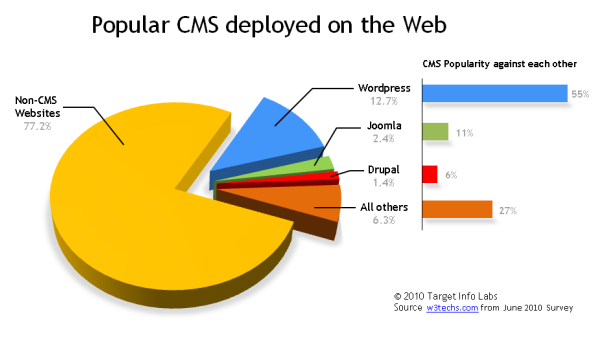
These open-source powerhouses, all built in PHP and boasting thousands of plugins, collectively power a whopping 16% of all websites, according to a June 2010 W3 Techs survey. Let’s break down why each of these CMS giants rocks and where they might stumble.
WordPress vs. Joomla vs. Drupal
WordPress: The User-Friendly Favorite
WordPress is the undisputed king of CMS. Popular sites like TechCrunch, ZDNet, and Phone.com swear by it. Here’s why:
- Easy Setup: WordPress’s setup wizard is a breeze, and many hosting providers offer it as a one-click install.
- Low Learning Curve: Designed in 2003 as the cooler, simpler alternative to MoveableType, ease-of-use is in its DNA.
- Plugin Heaven: With over 12,000 plugins, adding features like SEO, forms, galleries, newsletters, and more is a cinch.
- Thriving Developer Community: Need a custom feature? The vibrant WordPress community has your back.
- Support & Training: Tons of third-party commercial support and training make it perfect for corporate environments.
The Catch? While WordPress is strong, robust, and pretty secure (bye-bye, 2007 security woes), it can struggle with scalability. For high-traffic sites, load-balancing is a must, or you might want to explore other options.
2024 Update: WordPress still remains highly relevant, powering over 38% of all websites. Its ease of use, extensive plugin repository, and robust community support make it the go-to CMS for individuals, small businesses, and even larger enterprises.
Load balancing is no longer an issue since a number of WordPress dedicated/managed hosting sites have sprung up over the years. These sites take care off load balancing, security, updates and even automated backups. Search on Google for "Managed WordPress hosting" to get some options - or there's always WpEngine.com to look at.
WordPress vs. Joomla vs. Drupal
Joomla: The Flexible Middle Ground
Next up, we have Joomla – the cool kid that’s a step up from WordPress in terms of complexity, but with added flexibility, extensibility, and scalability. It’s a favorite among SMEs. Here’s the scoop:
- Ease-of-Use: It’s not as intuitive as WordPress, but it’s far from rocket science.
- Extensions Galore: With over 6,000 extensions, you can easily add shopping carts, newsletters, user profiles, surveys, lead-capture forms, and more.
- Scalability: While there’s no definitive documentation, general consensus puts Joomla’s scalability a few notches above WordPress.
- Strong Tech Community: Like WordPress, Joomla has a dedicated and robust tech community.
The Catch? Joomla doesn’t quite match WordPress in usability. It requires a bit more technical know-how and oversight, translating to higher setup and maintenance costs.
2024 Update: Joomla remains relevant, especially with users needing advanced customization and multilingual support. It powers around 2.3% of websites but faces stiff competition from WordPress and Drupal. Joomla offers extensive flexibility and a strong community, though it has a steeper learning curve and fewer, often outdated, extensions compared to WordPress. Despite its declining market share, Joomla is ideal for complex sites needing robust features but less complexity than Drupal.
WordPress vs. Joomla vs. Drupal
Drupal: The Powerhouse for Pros
Lastly, we have Drupal – the heavyweight champion for technical complexity and power. Major sites like MTV UK, The Economist, and Rutgers University rely on Drupal. Here’s why:
- Unmatched Power: Drupal is ideal for highly dynamic and complex websites.
- Module Rich: With over 7,000 robust modules, Drupal’s plugins are designed for serious customization.
- Developer’s Dream: Built for the true geek, Drupal boasts a massive developer community.
- Top Performance: While hard numbers are scarce, techies often tout Drupal’s superior performance.
The Catch? Drupal’s complexity makes it less suitable for small-to-medium-sized sites. It’s a beast of a system, demanding serious technical chops. Unless you need its advanced capabilities, simpler and cheaper options might be better.
2024 Update: Drupal continues to be a robust choice for building complex, secure, and scalable websites. Drupal's strengths include its unparalleled customization options, strong security features, and vibrant community support. It's widely used by government websites, educational institutions, and large enterprises such as NASA and Tesla due to its flexibility and powerful features. Recent updates, like the integration of CKEditor 5 and the introduction of "Recipes" for easier feature setup, further enhance its usability and appeal.
Choosing the Right CMS for Your Needs
In the showdown between WordPress vs. Joomla vs. Drupal there are no clear cut winners. It all depends on what you are trying to do:
- Go with WordPress if you want a user-friendly, easy-to-set-up, and highly supported platform. Perfect for blogs, small businesses, and sites with moderate traffic.
- Choose Joomla if you need more flexibility and scalability without diving into too much complexity. Great for SMEs looking to grow.
- Opt for Drupal if you’re running a highly dynamic, large-scale site and have the technical resources to manage it. Ideal for enterprise-level projects with high customization needs.
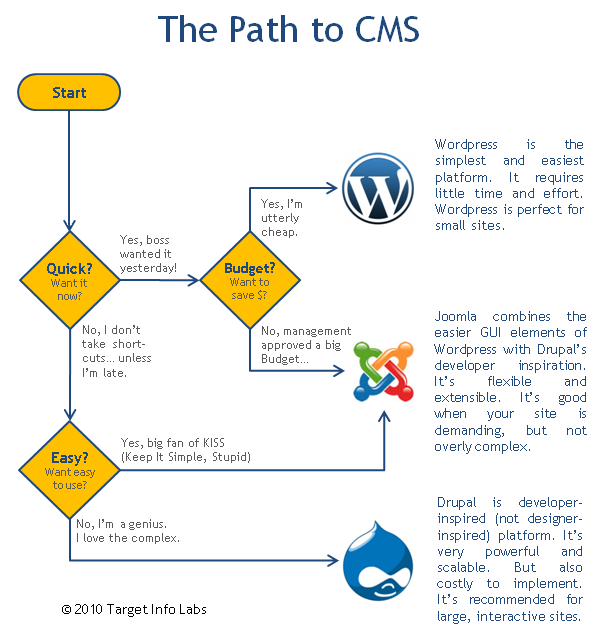
Still unsure? Use our handy flowchart below to find your CMS soulmate.
2024 Update: For businesses seeking more alternatives than just Wordpress vs. Joomla vs. Drupal in 2024, consider these platforms as well:
Squarespace and Wix for intuitive, drag-and-drop website building.Shopify and Magento for robust e-commerce solutions.Ghost for content-focused sites and blogs.Weebly for small businesses needing simplicity.Webflow for designers requiring advanced customization.HubSpot for Sales, Marketing, Support integration.
Each platform offers unique features tailored to different needs and skill levels
Ready to take your web presence to the next level? Reach out to ShoutEx, and let’s build something amazing together!