
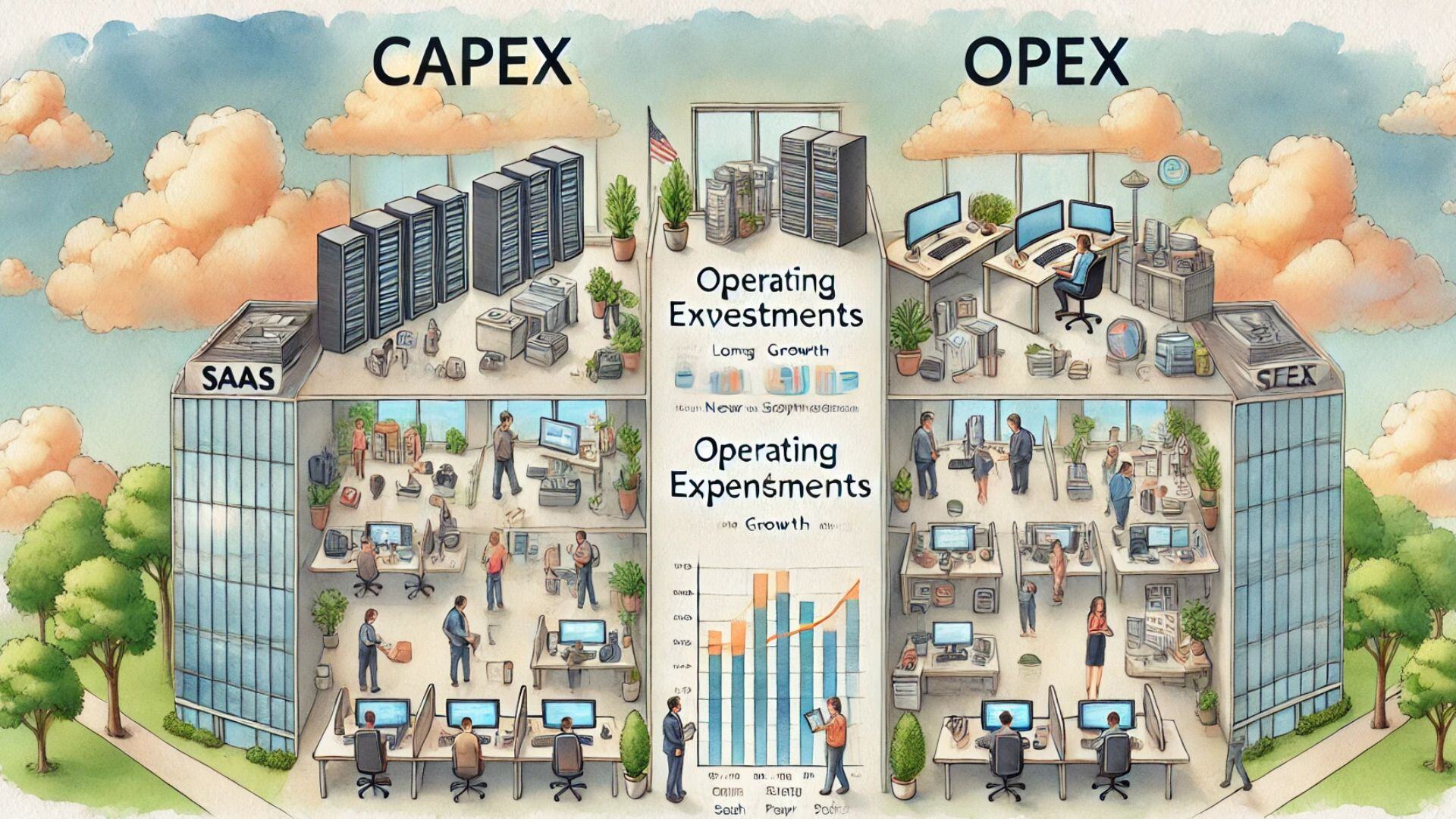
Managing expenses strategically determines whether SaaS startups scale sustainably or burn through cash chasing growth. Two fundamental expense categories drive this balance: Capital Expenditures (CapEx) and Operating Expenditures (OpEx).
Most founders know these terms exist. Far fewer understand how misclassifying expenses between the two categories distorts financial health, misleads investors, and creates problems during fundraising and exit scenarios.
This guide explains what CapEx and OpEx actually mean for SaaS companies, why the distinction matters, and how to manage each strategically.
What CapEx and OpEx Actually Mean
The difference between CapEx and OpEx isn't just accounting semantics. These classifications determine how expenses impact your financial statements, tax obligations, and investor perception.
Capital Expenditures (CapEx): Building for the Future
CapEx represents funds spent acquiring or upgrading long-term assets that provide value over multiple years. These are investments in your company's future capacity and capability.
For SaaS companies, CapEx typically includes developing proprietary technology, purchasing equipment or infrastructure, building out facilities, or acquiring other long-term assets.
The key characteristic: CapEx investments are depreciated over several years rather than expensed immediately. This spreads the financial impact across the asset's useful life.
Common SaaS CapEx examples:
- Developing proprietary software platform or core technology
- Purchasing servers or hardware infrastructure
- Building custom data centers or facilities
- Acquiring other companies or their technology
- Major upgrades to infrastructure that extend useful life
What counts as CapEx:
- Creates or acquires assets lasting multiple years
- Adds substantial new capability or capacity
- Improves asset performance or extends useful life
- Represents one-time or infrequent investment
- Capitalizable under accounting standards
Related: SaaS Startup Financial Modeling
Operating Expenditures (OpEx): Running the Business
OpEx covers day-to-day costs required to keep the business operating. These are shorter-term expenses fully deducted in the accounting period they occur.
For SaaS companies, OpEx dominates the expense profile. Recurring costs like cloud hosting, salaries, marketing, and software subscriptions all fall into OpEx.
The defining characteristic: OpEx is expensed immediately rather than capitalized and depreciated over time.
Common SaaS OpEx examples:
- Monthly cloud hosting and infrastructure costs
- Employee salaries, wages, and benefits
- Marketing and customer acquisition expenses
- Software subscriptions and tools
- Office rent and utilities
- Customer support and success costs
- Professional services and consulting
What counts as OpEx:
- Recurring costs to maintain operations
- Expenses that don't create lasting assets
- Day-to-day business necessities
- Fully consumed within the accounting period
- Expensed immediately on income statement
The modern SaaS model fundamentally favors OpEx over CapEx. Cloud infrastructure replaced owned data centers. Subscription software replaced licensed software. This shift from CapEx-heavy to OpEx-heavy models is one reason SaaS businesses scale differently than traditional software companies.
Related: What is MRR and Why It Matters in SaaS
Why SaaS Companies Must Get This Right
Misclassifying CapEx and OpEx creates problems that compound over time. What seems like a minor accounting detail becomes a major issue during fundraising, audits, or exit scenarios.
Cash Flow Distortion
When CapEx is misclassified as OpEx, financial statements suggest the business is burning cash on day-to-day operations when it's actually investing in long-term assets.
This makes the business appear less efficient than it actually is. Operating margins look worse. Burn rate seems higher. Investors question whether the business model is sustainable.
Conversely, when OpEx is misclassified as CapEx, the business looks deceptively profitable. Monthly operating costs appear lower than reality. This creates false confidence in unit economics and can lead to underestimating cash needs.
Cash flow impacts:
- Incorrect burn rate calculations
- Misleading runway projections
- False signals about operational efficiency
- Poor resource allocation decisions
- Unexpected cash shortfalls
Earnings Misrepresentation
Mixing CapEx and OpEx directly impacts reported earnings in ways that mislead stakeholders.
Capitalizing OpEx (treating operating expenses as capital investments) artificially inflates short-term earnings by deferring expense recognition. The income statement looks better now, but future periods bear the depreciation burden.
This manipulation becomes obvious during due diligence. Investors examining the books closely will catch misclassification and question either your financial competence or integrity.
Earnings impacts:
- Artificially inflated profitability
- Misrepresented EBITDA and operating margins
- Loss of investor trust during due diligence
- Difficult conversations during fundraising
- Potential audit issues and restatements
Related: Efficiency is Essential for SaaS
Financial Ratio Distortion
Key financial metrics investors use to evaluate SaaS companies depend on proper CapEx and OpEx classification.
Return on Assets (ROA): CapEx increases the asset base in the denominator while depreciation gradually reduces it. Misclassifying OpEx as CapEx artificially inflates assets and temporarily improves ROA before depreciation kicks in.
Operating Margin: OpEx directly reduces operating margin. Misclassifying OpEx as CapEx makes operating margins look better than reality.
EBITDA: Since depreciation is added back in EBITDA calculations, capitalizing expenses that should be OpEx artificially improves EBITDA by deferring expense recognition.
Leverage Ratios: Debt-financed CapEx increases leverage ratios. If those investments don't generate expected returns, you're left with high debt relative to equity.
Efficiency Ratios: High OpEx without proportional revenue growth signals inefficiency. Investors compare OpEx growth to revenue growth to assess operational leverage.
Related: Profitable, Efficient Growth for SaaS Startups
How CapEx Impacts SaaS Financial Metrics
Understanding CapEx's specific impact on financial metrics helps you make better investment decisions and communicate effectively with investors.
Impact on Return on Assets
CapEx investments increase total assets immediately while generating returns over time. This creates temporary ROA compression.
If you invest $1M in developing proprietary technology, assets increase by $1M immediately. But revenue and profit impacts accumulate gradually as you deploy and monetize that technology.
This is normal and expected. Investors understand CapEx investments depress ROA temporarily. The key is demonstrating that investments will generate sufficient returns over their useful life.
Impact on Leverage and Debt Coverage
Debt-financed CapEx increases leverage ratios by adding liabilities without immediate earnings impact.
If you borrow $500K to upgrade infrastructure, your debt-to-equity ratio increases immediately. The infrastructure improvements won't generate revenue or cost savings until implementation completes.
This makes the business look riskier in the short term. High leverage ratios during CapEx investment periods require clear communication about expected returns and timeline to payback.
Debt coverage ratios also compress because CapEx doesn't immediately increase EBITDA even though it increases debt service obligations.
Impact on Cash Flow Statements
CapEx appears in the investing activities section of cash flow statements, not operating activities. This distinction matters for investors evaluating operating cash flow generation.
Strong operating cash flow with negative investing cash flow signals a healthy business investing in growth. Weak operating cash flow with minimal investing activity suggests operational problems.
Related: SaaS Startup Funding Reality in 2025
How OpEx Impacts SaaS Financial Metrics
OpEx directly impacts the metrics investors scrutinize most closely when evaluating SaaS businesses.
Impact on Operating Margin and EBITDA
OpEx reduces both operating income and EBITDA dollar-for-dollar. This makes OpEx management critical for demonstrating path to profitability.
Investors compare operating margin trends to revenue growth to assess operational leverage. If revenue doubles while OpEx only increases 50%, you're demonstrating scaling efficiency. If OpEx grows faster than revenue, you have a unit economics problem.
Key OpEx efficiency metrics:
- OpEx as percentage of revenue (should decrease over time)
- OpEx growth rate vs revenue growth rate
- Sales and marketing efficiency (CAC payback period)
- R&D efficiency (revenue per R&D dollar)
- G&A scaling (decreasing as percentage of revenue)
Impact on Burn Rate and Runway
OpEx determines monthly burn rate for pre-profitable SaaS companies. This directly calculates runway—how long your cash lasts at current burn.
Reducing OpEx extends runway. Increasing OpEx accelerates burn. These calculations determine fundraising timing and urgency.
Investors want to see thoughtful OpEx management that balances growth investment with runway preservation. Cutting OpEx too aggressively sacrifices growth. Spending too freely risks running out of cash before achieving milestones needed for next funding round.
Impact on Unit Economics
Customer acquisition cost (CAC) and lifetime value (LTV) calculations both depend heavily on OpEx classification and management.
CAC is driven by sales and marketing OpEx. LTV is impacted by customer success and support OpEx. The LTV:CAC ratio—one of the most important SaaS metrics—depends on accurate OpEx tracking.
Misclassifying CAC-related expenses distorts your understanding of true customer acquisition costs and breaks unit economics analysis.
Related: What is MRR and Why It Matters in SaaS
Building a Strategic CapEx Approach
CapEx decisions shape your business for years. A strategic approach evaluates investments rigorously and monitors impacts carefully.
Use Capital Budgeting Techniques
Don't make CapEx decisions based on gut feel. Use formal capital budgeting methods to evaluate whether investments generate sufficient returns.
Net Present Value (NPV): Calculate the present value of expected future cash flows from the investment minus the initial cost. Positive NPV investments create value. Negative NPV investments destroy value.
Internal Rate of Return (IRR): Calculate the discount rate that makes NPV equal zero. IRR above your cost of capital suggests worthwhile investments. IRR below cost of capital means you'd be better off returning capital to investors.
Payback Period: How long until the investment generates enough cash to recover initial cost? Shorter payback periods reduce risk and free up capital for additional investments sooner.
These techniques force discipline into CapEx decisions. They require estimating future cash flows, which forces you to articulate exactly how the investment will generate returns.
Ensure Operating Cash Flow Supports CapEx
The ideal scenario is funding CapEx from operating cash flow rather than external capital. This demonstrates operational strength and reduces dilution.
Before committing to CapEx, verify your operating cash flow can support it without creating cash flow stress. If operating cash flow is insufficient, you need external financing.
Debt financing for CapEx can make sense when you have clear line of sight to returns that support debt service. Equity financing for CapEx signals to investors that you're investing in long-term value creation.
CapEx financing considerations:
- Can operating cash flow support this investment?
- If not, is debt financing available at reasonable terms?
- Will debt service obligations create cash flow stress?
- Does this investment justify equity dilution?
- What's the opportunity cost of this capital deployment?
Monitor CapEx Impact on Key Ratios
Track how CapEx investments impact financial metrics over time. This helps you understand whether investments are generating expected returns.
Monitor ROA trends after major CapEx investments. Initial compression is expected, but ROA should improve as the investment generates returns.
Watch leverage ratios if you debt-finance CapEx. Ensure debt-to-equity ratios stay within comfortable ranges and covenant requirements.
Track depreciation schedules to understand future P&L impacts from current CapEx decisions.
Related: SaaS Startup Financial Modeling
Building a Strategic OpEx Approach
OpEx management determines whether your SaaS business reaches profitability or burns through capital without achieving sustainable unit economics.
Optimize OpEx for Growth, Not Just Cost Cutting
Don't cut OpEx blindly to reduce burn. Strategic OpEx drives revenue growth and customer retention.
The question isn't "how can we spend less?" It's "which OpEx investments generate the best returns?"
Sales and marketing OpEx should generate new customers at acceptable CAC. Customer success OpEx should reduce churn and drive expansion. R&D OpEx should accelerate product development and competitive positioning.
Cut OpEx that doesn't drive these outcomes. Invest more in OpEx that demonstrably generates returns.
OpEx optimization approach:
- Calculate ROI for each major OpEx category
- Identify which expenses directly support revenue growth
- Cut or reduce expenses with unclear returns
- Invest more in high-ROI expense categories
- Test and measure new OpEx investments before scaling
Related: Efficient Growth for SaaS Startups
Distinguish Maintenance from Improvement
This distinction determines whether expenses should be OpEx or CapEx.
Maintenance expenses keep existing assets operating at current capacity and performance levels. These are OpEx.
Improvements add new capability, increase capacity, or materially extend useful life. These can be CapEx.
Maintenance (OpEx) examples:
- Monthly cloud hosting fees
- Routine server updates and patches
- Regular software maintenance
- Replacing broken equipment with equivalent replacements
Improvement (CapEx) examples:
- Major platform architecture overhaul
- Significant capacity expansion
- New features requiring substantial development investment
- Upgrades materially extending asset useful life
Getting this wrong creates tax issues and misrepresents financial position. When in doubt, consult with your accountant or CFO.
Monitor OpEx Efficiency Continuously
OpEx efficiency determines whether you're building a scalable business or one that requires constant capital infusion.
Track OpEx as percentage of revenue monthly. This percentage should decrease over time as you scale, demonstrating operational leverage.
Monitor specific OpEx categories against relevant benchmarks. Sales and marketing OpEx should trend toward 30-40% of revenue for efficient SaaS companies. R&D should be 15-25%. G&A should be 10-15%.
OpEx monitoring metrics:
- Total OpEx as percentage of revenue
- OpEx growth rate vs revenue growth rate
- Category-specific OpEx efficiency (sales/marketing, R&D, G&A)
- CAC and CAC payback period trends
- Gross margin trends (cost of revenue OpEx)
Use project management tools to track OpEx-related projects and ensure spending aligns with strategic priorities.
Related: SaaS Marketing KPIs
Common CapEx and OpEx Mistakes
Avoid these common errors that create financial problems down the road.
Capitalizing short-term expenses to inflate earnings: This manipulates financial statements temporarily but creates problems during due diligence and audits.
Treating all software development as CapEx: Only certain development activities qualify for capitalization under accounting standards. Most routine development is OpEx.
Debt-financing CapEx without clear ROI: Taking on debt for investments that don't generate sufficient returns to service that debt creates financial stress.
Cutting OpEx that drives revenue: Reducing sales, marketing, or customer success spending to extend runway often sacrifices growth that would have made fundraising easier.
Failing to track CapEx depreciation: Not monitoring depreciation schedules means future P&L impacts from current CapEx decisions surprise you.
Misclassifying maintenance as improvement: Treating routine maintenance as CapEx misrepresents financial position and creates tax issues.
Ignoring OpEx efficiency trends: Allowing OpEx to grow faster than revenue without justification signals poor unit economics.
CapEx vs OpEx: Quick Reality Check
Assess whether you're managing these expense categories properly:
CapEx accuracy: Are you capitalizing short-term expenses to artificially boost earnings? If yes, stop. This creates bigger problems later.
Financing strategy: Do you have a clear plan for financing CapEx without overstraining cash flow? Consider whether operating cash flow, debt, or equity financing makes most sense.
OpEx efficiency: Is your OpEx driving measurable revenue growth and customer retention? Or are you spending without clear returns?
Ratio monitoring: Do you track how CapEx and OpEx decisions impact key financial metrics investors care about?
Classification discipline: Do you have clear processes for determining whether expenses should be CapEx or OpEx? Or do you make ad hoc decisions?
Related: SaaS Startup Financial Modeling
The SaaS Shift: From CapEx to OpEx
The SaaS business model fundamentally favors OpEx over CapEx compared to traditional software or infrastructure businesses.
Traditional software companies made significant CapEx investments in servers, data centers, and infrastructure they owned and operated. SaaS companies rent this infrastructure from cloud providers, converting CapEx to OpEx.
This shift offers several advantages. Lower upfront capital requirements make SaaS startups more accessible. Flexible capacity scales with revenue without big capital investments. Pay-as-you-go pricing aligns costs with growth.
But the OpEx-heavy model also creates challenges. High monthly burn rates require consistent cash inflow or external capital. Unit economics must be sound because you can't defer costs through capitalization. Operational efficiency becomes critical for profitability.
Understanding this fundamental shift helps you manage your SaaS business appropriately. Don't apply traditional software financial strategies to SaaS models.
Related: The Future of SaaS in 2025: Is the Model Overplayed?
Communicating CapEx and OpEx to Investors
Investors evaluate CapEx and OpEx patterns to assess business health, efficiency, and growth potential.
What Investors Look For
CapEx discipline: Are you making thoughtful long-term investments with clear ROI? Or are you capitalizing routine expenses to manipulate earnings?
OpEx efficiency: Is OpEx growing slower than revenue, demonstrating operational leverage? Or are costs growing faster than revenue?
Unit economics: Do your OpEx-driven unit economics (CAC, LTV) demonstrate sustainable growth? Or do you lose money on every customer?
Cash management: Are you balancing growth investment with runway preservation? Or are you burning cash without clear path to profitability?
How to Present CapEx and OpEx Effectively
Be transparent about classification decisions. Explain why specific expenses are treated as CapEx vs OpEx.
Show trends over time, not just current period snapshots. Demonstrate that OpEx is scaling efficiently relative to revenue growth.
Connect CapEx investments to strategic priorities and expected returns. Don't just say "we invested in infrastructure." Explain what that infrastructure enables and when you expect ROI.
Address efficiency metrics directly. Don't make investors dig through financials to calculate OpEx as percentage of revenue or CAC trends.
Related: Raising VC Funds
CapEx and OpEx aren't just accounting categories—they're strategic tools for managing growth, profitability, and investor perception in SaaS businesses.
CapEx represents investments in long-term assets that generate value over multiple years. OpEx covers day-to-day operating costs that keep the business running.
Proper classification between the two impacts cash flow management, earnings representation, financial ratios, and investor confidence. Misclassification creates problems that compound during fundraising, audits, and exit scenarios.
Build strategic approaches to both. Evaluate CapEx investments using formal capital budgeting techniques. Optimize OpEx for growth and efficiency, not just cost cutting. Monitor impacts on key financial metrics continuously.
The SaaS model favors OpEx over CapEx compared to traditional software. Embrace this shift while managing the resulting need for strong unit economics and operational efficiency.
Related reading:
Startup Hub