
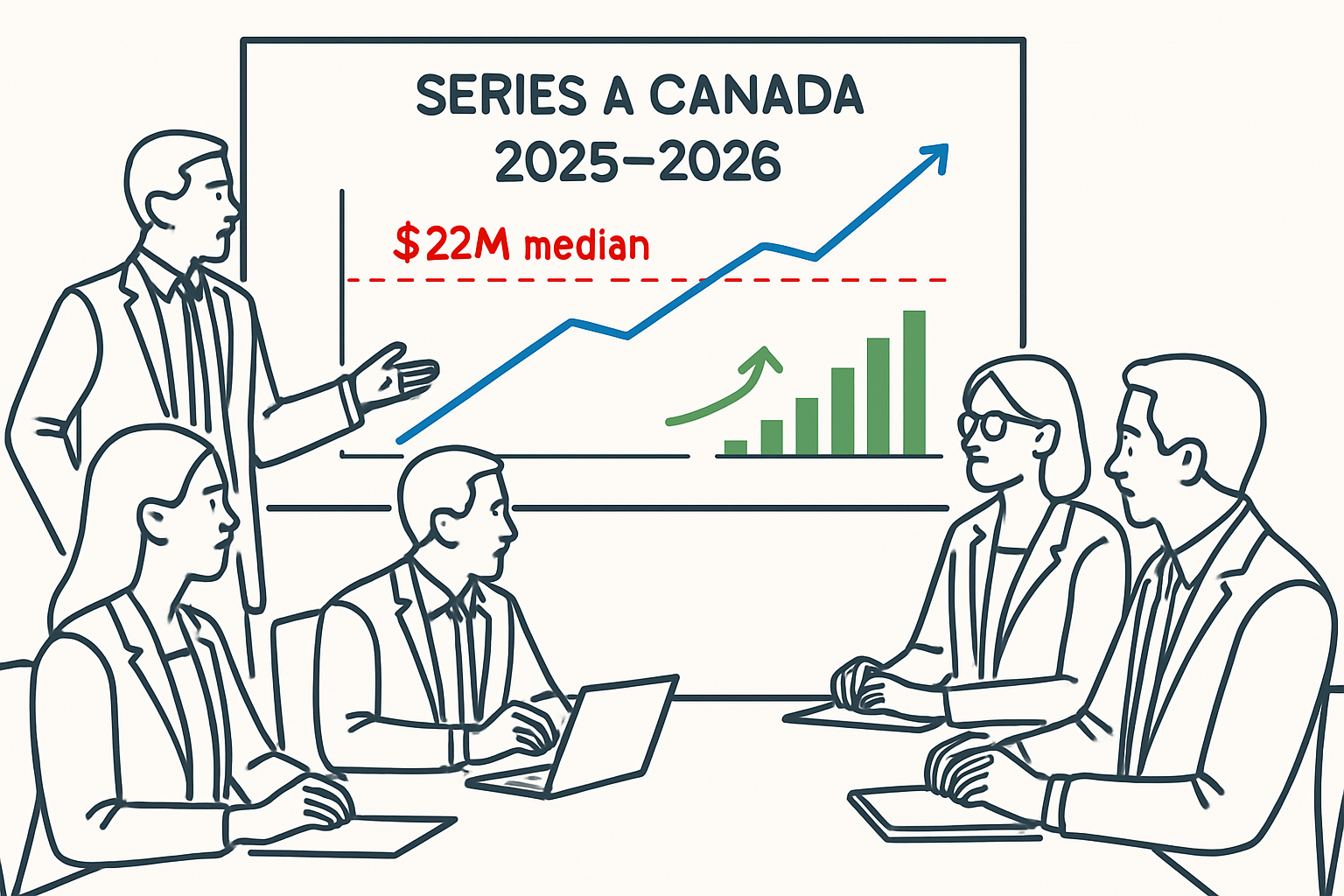
Series A funding in Canada quietly but materially changed in 2025–2026. Not in a way that makes headlines, but in a way that reshapes how companies are evaluated, how rounds are structured, and which founders advance versus stall.
The most visible signal is numerical: the median Series A round increased to approximately $22M, up from roughly $15M just a few years earlier. But the size increase is not the story. The reason it increased is what founders need to understand.
This was not a loosening of standards. It was the opposite.
Why Series A Rounds Got Larger, Not Easier
Larger Series A rounds reflect higher conviction thresholds, not greater risk appetite. Canadian investors are concentrating capital into fewer companies that have already cleared multiple filters before the round closes.
Funds are underwriting more risk before Series A, then writing larger checks once uncertainty has been reduced. As a result, Series A now functions less like a growth experiment and more like a scaling authorization.
For founders, this means fewer “almost-ready” companies are getting through. Those that do are being capitalized more heavily so they can execute without returning to market prematurely.
What Investors Now Expect Before Series A
The definition of Series A readiness has shifted. In 2026, investors are no longer persuaded by directional momentum alone. They expect clarity.
Most firms now look for a combination of repeatable go-to-market motion, early proof of sales efficiency, and evidence that the team understands where growth breaks under pressure. This does not mean flawless metrics, but it does mean explainable ones.
Founders are expected to know which levers drive growth, which constraints matter most, and how capital will be allocated to remove specific bottlenecks. Vague growth narratives that once passed are now filtered out early.
The Real Reason Median Round Size Increased
The increase to a $22M median is partly structural. Funds want to avoid bridge rounds, insider-led extensions, and constant fundraising distraction. Larger Series A rounds give companies 24 to 36 months of operational runway with enough capital to test expansion paths decisively.
But there is also a signaling function. A larger round communicates internal alignment at the fund level. It tells LPs and co-investors that this company is one of a small number the fund is backing with real conviction.
For founders, this means Series A is no longer about optionality. It is about commitment, on both sides.
How This Changes Founder Strategy
Founders approaching Series A in 2026 need to adjust their preparation timelines and internal expectations. Raising earlier to “see how it goes” is no longer viable. The work has moved left.
Teams now need to enter the raise with a tighter understanding of customer acquisition dynamics, a clearer segmentation strategy, and a credible plan for scaling the one motion that already works. Trying to fund discovery at Series A is a fast path to prolonged diligence and quiet rejection.
This also affects hiring. Investors increasingly expect leadership depth planning before the round, not after. A credible Series A company shows awareness of where the founding team will need reinforcement as the organization grows.
What Did Not Change
Despite larger checks, Canadian Series A remains disciplined. Valuations are still grounded in fundamentals, not hype. Capital efficiency still matters. Burn without learning is penalized quickly.
What changed is not investor philosophy, but investor patience. Fewer companies are funded, but those that are receive more focused support and more meaningful capital.
A Practical Takeaway for Founders
If you are planning a Series A in Canada, ask yourself a simple question: are you raising to find your model, or to scale a model you already understand?
If the answer is the former, you are early. If it is the latter, the market is prepared to back you more meaningfully than before.
Series A in 2026 is not a reward for progress. It is an endorsement of clarity.
Disclaimer
This content is for general information only and does not constitute legal, financial, or investment advice. Outcomes are not guaranteed; external resources are provided without warranty or endorsement, and founders should consult qualified professionals for decisions about fundraising, valuations, and capital strategy.
ShoutEx Insights
- Canadian Startup Ecosystem: Ultimate Guide 2026
- How to Raise Seed Funding in Canada
- Canadian VC Guide for Founders
- Top 25 Canadian VCs: Investment Landscape
- From Canadian MVP to Series A: Growth Journey
- Canadian Startup Valuations: Understanding the Market
- How to Approach Canadian VCs: Founder's Playbook
- Raising VC Funds: Strategic Approach for Founders
- SaaS Startup Funding Reality 2025
Further Readings:
- Hiring Trends in Canada
- BDC Capital: Growth Stage Venture Capital
- Canadian Venture Capital Association: Series A Trends
- Crunchbase: Canadian Series A Data
- Export Development Canada: Growth Financing
- Innovation, Science and Economic Development Canada
- Globe and Mail: Canadian VC and Growth Funding News
- BetaKit: Canadian Scale-Up Coverage
- Pitchbook: Series A Market Intelligence
Last updated by the Team at ShoutEx on January 19, 2026.
Frequently Asked Questions
Why did Series A round sizes increase in Canada between 2025 and 2026?
Round sizes increased because investors are concentrating larger checks into fewer companies that have already reduced uncertainty, not because they are taking more risk. Series A now acts more like authorization to scale a validated model than an experiment to find one.
Did Canadian Series A standards become looser when round sizes went up?
No. Standards became stricter. Investors now expect clearer proof of repeatable go‑to‑market, early sales efficiency, and a strong grasp of where growth breaks before they commit to a larger round.
What do Canadian investors expect to see before leading a Series A in 2026?
They typically look for one repeatable GTM motion, explainable metrics, and evidence that the team understands the key levers and constraints in the business. Founders are also expected to show how new capital will be deployed to remove specific bottlenecks, not just “fuel growth.”
How does the larger median Series A round affect founder strategy?
Founders can no longer “test the waters” with an early Series A; they need to arrive with a validated model ready to scale. Preparation around segmentation, customer acquisition economics, and org design must be done before the raise, not after.
What stayed the same about Series A funding in Canada?
Despite bigger checks, investor discipline remains high: valuations are still tied to fundamentals, capital efficiency matters, and undisciplined burn is penalized. What changed is that fewer companies are funded, but those that are receive more conviction and runway.
How should founders decide if they are ready for a Series A in Canada?
A founder is closer to ready when the raise is meant to scale a model they already understand, not to discover one. If the goal is still to figure out core economics, messaging, or ICP, the company is likely early for a strong Series A.
What organizational expectations do investors have at Series A now?
Investors increasingly expect founders to have thought through leadership depth, key hires, and how responsibilities will evolve as the company scales. A credible Series A story includes not just revenue and product plans, but also how the team will grow to support them.