
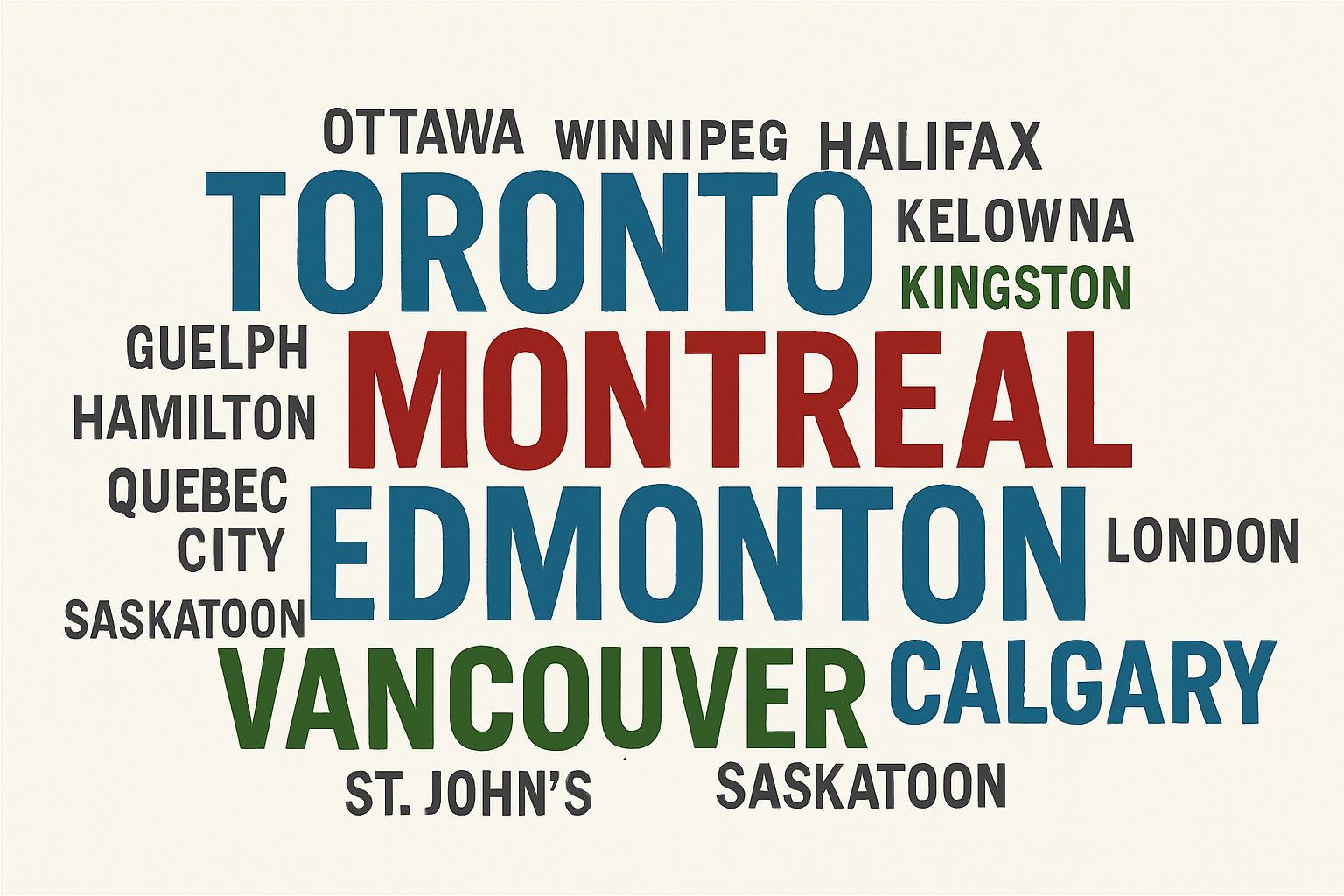
Canada’s AI startup ecosystem is not a single market. It is a distributed system of city-level specializations, each shaped by different research roots, commercial incentives, and buyer access. Founders who treat “Canadian AI” as one category tend to misposition themselves. Founders who understand where their AI company fits geographically tend to scale faster and raise with less friction.
This guide connects Canada’s major AI cities to their dominant verticals and explains how founders should use city ecosystems strategically, not symbolically.
Toronto: Applied AI, Enterprise Buyers, and Commercial Pressure
Toronto is Canada’s most commercially dense AI hub. The city’s strength lies not in foundational research alone, but in applied AI deployed into real buying environments. Enterprise software, fintech, healthtech, and regulated industries dominate the landscape. Buyers are sophisticated, procurement cycles are real, and AI claims are tested quickly.
Toronto-based AI startups tend to succeed when they can translate technical capability into operational value. Models matter, but explainability, compliance, and integration matter more. This is why Toronto is especially strong for AI layered into existing workflows rather than entirely new paradigms.
Founders building AI companies here benefit from proximity to customers, capital, and later-stage talent, but they also face higher expectations earlier. ShoutEx’s Toronto and Ontario city coverage breaks down the accelerators, enterprise pathways, and funding dynamics that define this environment.
Montreal: Foundational AI, Research Depth, and Technical Credibility
Montreal remains Canada’s intellectual center of gravity for AI. The ecosystem is anchored by universities, research labs, and globally recognized scientists. As a result, Montreal excels in foundational models, advanced ML research, and technically ambitious startups.
AI companies in Montreal are often judged first on technical rigor. Claims are scrutinized. Architectures are questioned. Assumptions are challenged. This creates friction for founders who want to rush to market, but it creates enormous credibility for those whose technology holds up.
Montreal is particularly strong for AI-first companies in natural language processing, computer vision, and scientific AI. It is also well-suited for founders whose competitive advantage is genuinely technical rather than purely data-driven or distribution-led. ShoutEx’s Montreal and Quebec coverage details how founders can leverage this ecosystem without getting stuck in research mode.
Edmonton: Applied AI, Industrial Context, and Real-World Deployment
Edmonton has quietly become one of Canada’s most practical AI hubs. Its strength lies in applied AI deployed into industrial, energy, logistics, and infrastructure environments. Unlike Toronto or Montreal, Edmonton’s ecosystem is deeply connected to physical systems and operational data.
AI startups here often work with messy data, constrained environments, and real-world failure modes. That makes Edmonton particularly strong for applied machine learning, optimization, and AI systems that must perform under non-ideal conditions.
Founders building AI for industrial use cases, climate, energy transition, or large-scale operations often find Edmonton more aligned than larger markets. Access to pilots, domain experts, and applied funding creates a different kind of momentum. ShoutEx’s Alberta city articles outline how these programs connect founders to deployment opportunities rather than just demos.
How Vertical Focus Maps to City Advantage
The strongest Canadian AI startups align their vertical focus with the city best equipped to support it. Enterprise and regulated AI fits naturally in Toronto. Research-heavy and model-driven AI fits Montreal. Operational and industrial AI fits Edmonton.
This does not mean founders must relocate permanently, but it does mean they should be intentional about where they incubate, pilot, fundraise, and recruit. City ecosystems act as accelerators when aligned and as drag when misaligned.
Using City Ecosystems as a System, Not a Choice
The most effective founders treat Canadian cities as a sequenced system, not a binary choice. It is increasingly common to see companies incubate technically in Montreal, commercialize in Toronto, and deploy pilots through Alberta-based programs. This is not fragmentation. It is leverage.
Canada’s advantage in AI is not scale. It is specialization. Founders who understand that build companies that look more credible, more focused, and more investable at every stage.
Final Perspective
Canada’s AI ecosystem is strongest when viewed city by city and vertical by vertical. Toronto, Montreal, and Edmonton are not competitors. They are complementary nodes in a national system that rewards clarity over hype.
Founders who align their AI strategy with the right city at the right time do not just move faster. They waste less energy proving the wrong things to the wrong audiences.
Disclaimer
This content is for general informational purposes only and is not legal, financial, or technical advice. External resources are provided without warranty or endorsement, and outcomes will vary based on each founder’s specific context, strategy, and execution.
ShoutEx Insights
- Canadian Startup Ecosystem: Ultimate Guide 2026
- Toronto's Startup Ecosystem: Canada's Tech Capital
- Montreal's Startup Ecosystem: Quebec's Innovation Powerhouse
- Vancouver's Startup Ecosystem: BC's Tech Innovation Leader
- Waterloo's Startup Ecosystem: Tech Innovation Hub
- Edmonton's Startup Ecosystem: Alberta Innovation Center
- How to Raise Seed Funding in Canada
- Canadian Government Grants and Startup Funding
- Tech Talent by Canadian City: Regional Analysis
- Why AI search traffic converts better
- The truth about outbound AI
- AI and investor relations expectations
- Funding reality for SaaS founders
- Positioning mistakes to avoid
Further Readings:
- Hiring Trends in Canada
- CIFAR: Pan-Canadian AI Strategy
- Scale AI: Canadian AI Supercluster
- Creative Destruction Lab: AI Stream
- BetaKit: Canadian AI Startup News
- Canadian Institute for Advanced Research: AI Programs
- Vector Institute – Toronto AI ecosystem and programs
-
Amii – Alberta Machine Intelligence Institute and industry programs
Frequently Asked Questions
How should founders choose their primary AI city in Canada?
Founders should match their dominant vertical to the city optimized for that work: enterprise and regulated AI in Toronto, research-heavy and model-driven AI in Montreal, and operational or industrial AI in Edmonton. They can then plan where to incubate, pilot, fundraise, and recruit based on which stakeholders are most concentrated in each city.
Do AI founders need to relocate to benefit from a city’s strengths?
Founders do not need to move permanently, but spending focused time in the right city at the right stage helps reduce friction in sales, hiring, and fundraising. Many teams maintain a distributed presence while anchoring specific activities—like research or enterprise selling—in the best-fit city.
What makes Toronto distinct as an AI hub?
Toronto is strongest where AI must survive real procurement: enterprise software, fintech, health, and regulated industries that demand explainability, compliance, and integration. Startups that plug into existing workflows and show operational value early tend to outperform purely experimental AI projects here.
When is Montreal the best starting point for an AI startup?
Montreal is ideal when a startup’s edge is technical depth—novel architectures, foundational models, or advanced ML in NLP, vision, or scientific domains. Teams gain credibility by pressure-testing their assumptions in a dense, research-first ecosystem.
Which founders should prioritize Edmonton?
Edmonton suits founders working on AI that touches physical systems, industrial processes, climate, energy, and large-scale logistics. Access to messy data, industrial partners, and applied pilots helps these companies validate robustness under real-world constraints.
Can founders sequence multiple Canadian AI cities as they scale?
Yes, many promising companies incubate technically in Montreal, commercialize in Toronto, and run large-scale pilots via Alberta programs anchored around Edmonton. Treating cities as a system rather than a single choice turns geographic specialization into a growth advantage.