
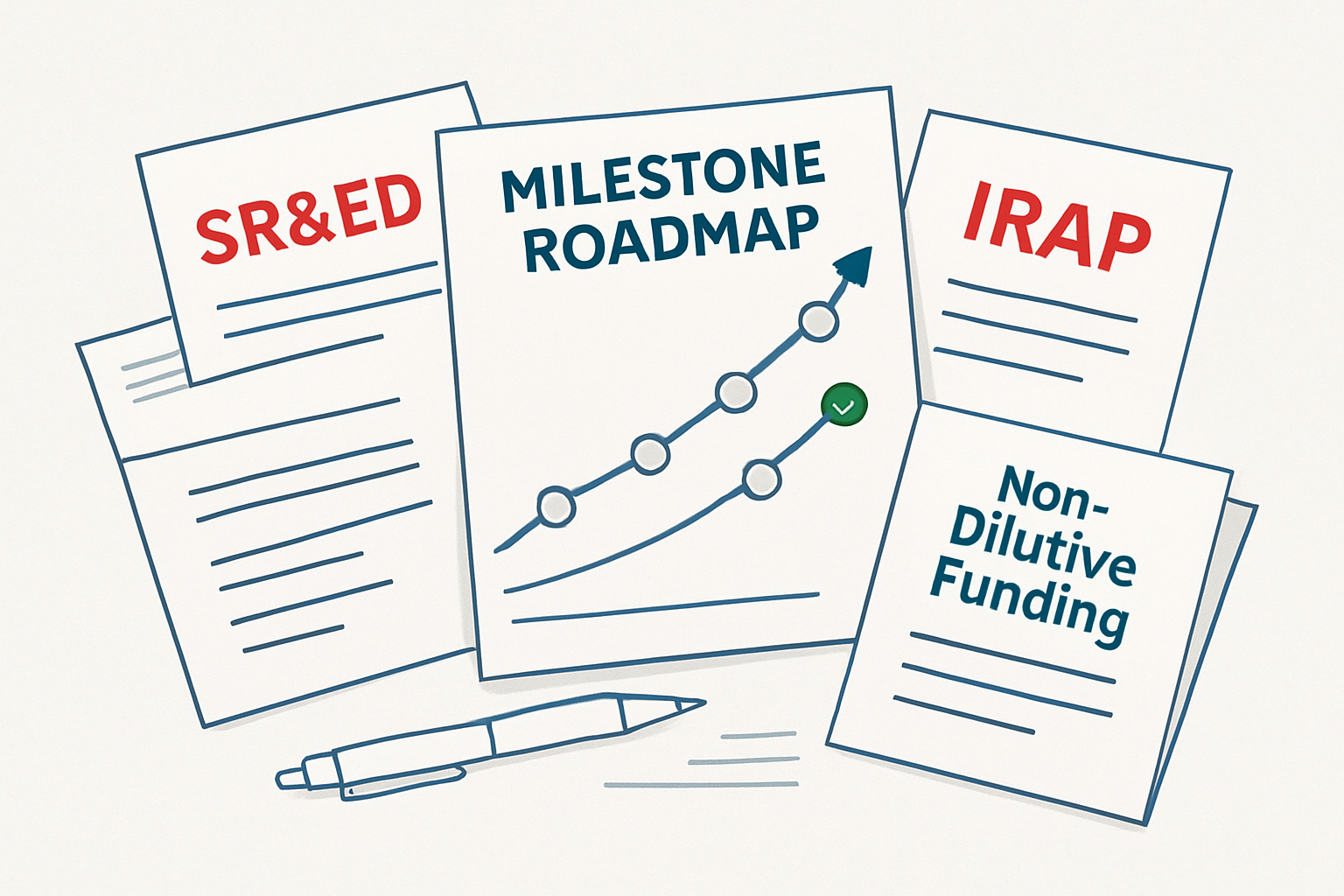
For Canadian founders, non-dilutive funding is not a side quest. It is a core capital strategy. Used properly, government grants can extend runway, reduce dilution, and de-risk innovation long before venture capital enters the picture. Used poorly, they become a distraction, an administrative burden, or worse, a false sense of financial security.
This guide is a practical, founder-grade breakdown of how government funding actually works in Canada in 2026, what programs matter most, and how strong companies integrate grants into a coherent financing plan rather than chasing every dollar available.
Why Non-Dilutive Funding Matters More in Canada Than Elsewhere
Canada’s startup ecosystem is structurally different from the U.S. Venture capital is more conservative, rounds take longer to close, and investors expect capital efficiency earlier. Government funding exists to offset these realities, but it only helps founders who treat it as strategic infrastructure, not free money.
Non-dilutive funding is most powerful when it supports three things: technical risk reduction, early team building, and validation milestones that make private capital easier to raise later. It is weakest when used to mask the absence of traction or product clarity.
SR&ED: Still the Backbone, Still Misunderstood
The Scientific Research and Experimental Development program remains the single most important non-dilutive funding mechanism for Canadian startups. At its core, SR&ED rewards companies for attempting technically uncertain work where outcomes are not guaranteed.
In 2026, successful SR&ED claims share common traits. They focus on genuine technical uncertainty, document decision-making rigorously, and tie experimentation directly to product outcomes. Claims that overreach, reframe routine development as “innovation,” or lack contemporaneous documentation increasingly face scrutiny.
For founders, the key shift is mindset. SR&ED is not about tax optimization. It is about building disciplined engineering and experimentation practices that stand up to review. Teams that do this well often find SR&ED becomes predictable, repeatable capital rather than a once-a-year scramble.
IRAP: Validation Capital, Not Growth Capital
The Industrial Research Assistance Program plays a different role. IRAP is designed to support early-stage innovation by funding specific R&D initiatives and talent. It is particularly valuable for companies that are still proving feasibility or developing novel technical capabilities.
IRAP funding works best when it is tied to a clearly defined project with measurable outcomes. It is less effective as general operating support. Founders who succeed with IRAP typically have a strong technical roadmap, a credible internal champion, and a realistic understanding of reporting requirements.
Importantly, IRAP also serves as a signal. Private investors often view successful IRAP participation as third-party validation of technical merit, especially in deep tech, advanced software, and applied AI.
Beyond SR&ED and IRAP: The Broader Landscape
Canada’s non-dilutive funding ecosystem extends well beyond the two headline programs. Provincial incentives, sector-specific grants, export support, and regional development funds can meaningfully supplement early-stage capital when aligned properly.
Programs tied to clean technology, life sciences, manufacturing, and workforce development are particularly active in 2026. However, these funds are narrower in scope and less forgiving of misalignment. Founders should approach them selectively, based on strategic fit rather than availability.
The strongest companies treat these programs as modular. Each grant supports a specific milestone, team hire, or market expansion step, rather than becoming a patchwork of unrelated funding sources.
How Investors View Government Funding
Contrary to some founder fears, venture investors do not penalize companies for using government grants. They penalize companies that rely on them improperly.
Investors respond positively when non-dilutive funding is used to accelerate learning, extend runway efficiently, or de-risk technical bets. They become cautious when grants substitute for customer traction, distort priorities, or introduce operational drag.
The difference is intent and execution. Used strategically, grants improve capital efficiency. Used defensively, they delay hard decisions.
A Practical Framework for Founders
Before pursuing any government funding, founders should ask three questions. Does this funding advance a milestone that private capital will care about? Can the team execute the requirements without slowing the core business? And does this program align with where the company will be in 12 to 18 months?
If the answer to any of these is no, the funding is likely not worth pursuing.
Non-dilutive capital should simplify your path forward, not complicate it.
Final Perspective
Government grants in Canada are neither a shortcut nor a crutch. They are a lever. In 2026, the founders who use them best are not those who maximize claims, but those who integrate grants into a disciplined, milestone-driven financing strategy.
When aligned with product clarity and execution, programs like SR&ED and IRAP can materially change outcomes. When misused, they quietly stall companies that otherwise had potential.
Treat non-dilutive funding with the same rigor you apply to venture capital. The returns, in flexibility and control, are often worth it.
Disclaimer
This content is for general information only and does not constitute legal, tax, or investment advice. Government programs, eligibility rules, and timelines change frequently; founders should verify details on official sites and consult qualified advisors before relying on any specific funding source.
ShoutEx Insights
- Canadian Startup Ecosystem: Ultimate Guide 2026
- How to Raise Seed Funding in Canada
- Canadian Software Startups Tax Credits Guide
- IRAP and SR&ED: Government Funding Options for Canadian Startups
- Series A Funding in Canada: Complete Guide
- Canadian VC Guide for Founders
- Incorporating a Startup in Canada: Legal Essentials
- Starting a Tech Company in Canada: Founder's Guide
- Complete Guide to Canadian Startup Accelerators and Incubators
Further Readings:
- Hiring Trends in Canada
- National Research Council: IRAP Funding Program
- Canada Revenue Agency: SR&ED Tax Incentive
- Innovation, Science and Economic Development Canada: Funding Programs
- BDC: Government-Backed Small Business Financing
- Export Development Canada: Financial Solutions
- Futurpreneur Canada: Young Entrepreneur Financing
- Regional Development Agencies: Provincial Funding
- Canadian Innovation Commercialization Program
Last updated by the Team at ShoutEx on January 19, 2026.
Frequently Asked Questions
What is SR&ED and why is it so important for Canadian startups?
SR&ED is a federal tax incentive program that provides credits and refunds for eligible R&D work conducted in Canada. It is one of the largest sources of non‑dilutive capital for startups, often returning a meaningful portion of technical salaries and experimentation costs each year.
What kind of work actually qualifies for SR&ED in 2026?
Eligible SR&ED work must involve systematic investigation or experimentation aimed at resolving scientific or technological uncertainty, not routine development. Claimants need to show a clear obstacle, a hypothesis, a plan of experimentation, and contemporaneous records of what was tried and learned.
How is IRAP different from SR&ED for founders?
IRAP is a proactive funding program that can cover a portion of eligible R&D project costs and technical hires via contribution agreements. SR&ED, by contrast, is a tax incentive you claim after spending, which can reduce taxes payable or result in a refund depending on your status.
Who is eligible for IRAP funding in Canada?
IRAP targets incorporated, profit‑oriented Canadian SMEs with fewer than 500 employees that are pursuing technology‑driven innovation and commercialization. Applicants need a credible business plan, financials, and a project that advances new or improved products, services, or processes in collaboration with an Industrial Technology Advisor.
What other non-dilutive programs exist beyond SR&ED and IRAP?
Founders can access a range of federal and provincial grants covering digital adoption, export development, clean tech, life sciences, manufacturing, and regional development. These often provide project‑based grants or cost‑sharing for expansion, hiring, and market entry, but have narrower mandates and stricter fit requirements.
Do investors view heavy use of grants as a red flag?
Investors generally appreciate grants when they de‑risk technical work, extend runway, or fund clear milestones without distorting focus. Concerns arise when a company depends on grants instead of customer revenue, chases misaligned programs, or struggles with the administrative burden of multiple overlapping initiatives.
How should founders decide if a particular grant or program is worth pursuing?
Founders should confirm that the program funds a milestone that future investors or customers will care about, that the team can manage reporting and compliance, and that the timing aligns with the company’s 12–18 month plan. If a grant mainly looks attractive as “free money” and complicates priorities, it is usually better to skip it.