
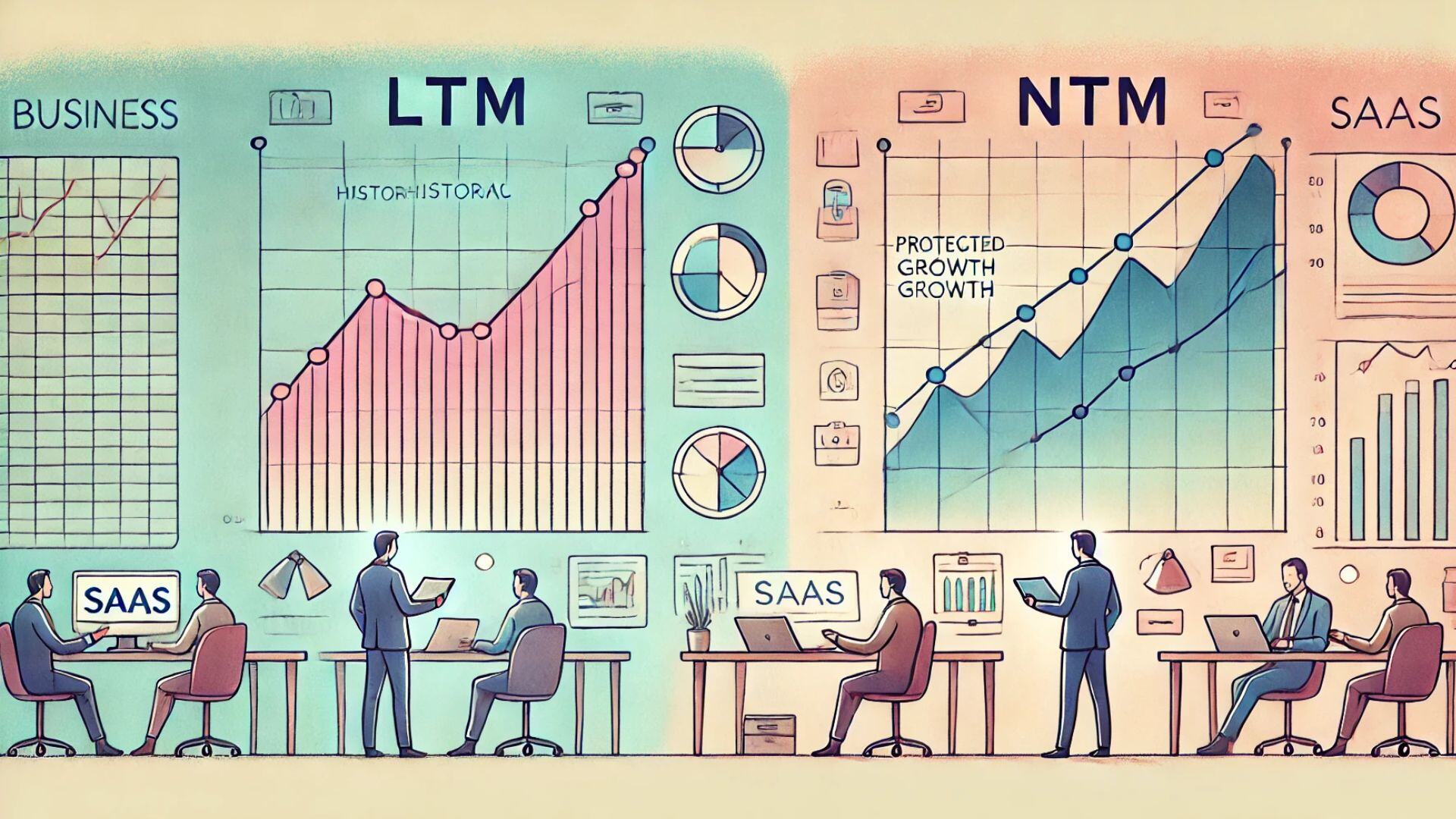
When a VC asks, "What's your enterprise value?" or "What multiple are you looking for?" many founders freeze. The answer depends on a choice most don't even realize they're making: are you valuing the business on what it did (LTM) or what it will do (NTM)?
This choice matters enormously. The difference between an LTM and NTM multiple can swing your valuation by millions of dollars. In the example of a $20M ARR SaaS company, the choice between LTM and NTM can mean the difference between a $150M and $250M valuation at the same multiple.
Understanding which metric to use, when to use it, and how to defend your choice is critical for founders navigating fundraising, M&A, or board conversations. As you build within the Canadian Startup Ecosystem, understanding how investors evaluate SaaS companies using these multiples becomes essential. Regional VCs and strategic buyers may weight these metrics differently than Silicon Valley investors, which means knowing how to frame your valuation argument matters.
This guide breaks down the mechanics, the when-to-use framework, and how to position your company correctly.
What Are LTM and NTM? The Core Definitions
Let's start with clarity on terminology, because precision matters in valuation conversations.
LTM (Last Twelve Months) refers to your actual historical revenue from the past twelve months. It's also called TTM (Trailing Twelve Months). If today is January 2026, your LTM is the revenue you generated from January 2025 through December 2025.
The critical word is actual. LTM is not projected. It's not estimated. It's the real revenue your company generated.
NTM (Next Twelve Months) refers to your projected revenue for the upcoming twelve months. If today is January 2026, your NTM is your forecast for revenue from January 2026 through December 2026.
The critical word is projected. NTM is based on assumptions about customer acquisition, expansion, churn, and pricing.
Both metrics are used to calculate enterprise value by applying a multiple:
Enterprise Value = Revenue × Multiple
If your LTM revenue is $15M and the multiple is 10x, your enterprise value is $150M. If your NTM revenue is $25M at the same 10x multiple, your enterprise value is $250M.
The choice of whether to use LTM or NTM fundamentally changes the valuation conversation.
LTM Multiples: The Historical View
LTM multiples are anchored in reality. You can't argue about LTM revenue; it either happened or it didn't. This objectivity is both LTM's greatest strength and its greatest limitation.
When to Use LTM Multiples
Mature SaaS companies – If your company has been operating for five+ years with stable, predictable growth (15-30% YoY), LTM is the appropriate metric. Mature companies trade closer to LTM because past performance is a reliable indicator of future performance.
Stable, lower-growth businesses – If you're a profitable, cash-flowing SaaS company with single-digit or low-teens growth, LTM multiples apply. Investors care about what you've demonstrated you can do, not what you promise to do.
Financial reporting and comparables – When analyzing public companies or building valuation comparables, LTM is the standard. Public company valuation multiples are calculated on LTM revenue.
Conservative lenders or acquirers – Banks and debt providers use LTM because it's objective. Strategic acquirers focused on reducing risk also often anchor to LTM.
Strengths of LTM
Objective and verifiable – LTM is not debatable. Your audited or reviewed financials show exactly what happened. There's no assumption risk.
Reflects actual execution – LTM proves you can deliver. You can't talk your way out of LTM; you either hit your numbers or you didn't.
Stable for mature companies – If your business is mature and predictable, LTM is a reliable representation of ongoing value.
Reduces investor risk – Investors who anchor to LTM know exactly what they're buying. There's no surprise when projections miss.
Limitations of LTM
Misses growth momentum – If you were growing 10% annually last year but you've accelerated to 50% growth this year, LTM doesn't capture that momentum. It reflects yesterday's company, not today's.
One-time events can distort it – A large customer acquisition or loss, a product launch, a price increase—any non-recurring event skews LTM. A company that lost a major customer last month looks worse than it actually is. A company that just landed a whale looks better.
Penalizes young, fast-growing companies – If you've been operating for only eighteen months and you were doing $2M ARR a year ago but now $8M, your LTM reflects the average ($5M) rather than your current run rate. LTM undervalues hypergrowth companies.
Doesn't reflect market shifts – If your market has just started accelerating or if you've just launched a breakthrough product, LTM doesn't reflect that shift.
For young, fast-growing SaaS companies, relying solely on LTM multiples leaves significant value on the table during funding or M&A discussions.
NTM Multiples: The Forward-Looking Perspective
NTM multiples are anchored in the future. They ask: "If the company executes its plan, what will it be worth?" This forward orientation makes NTM valuable for high-growth companies but introduces assumption risk.
When to Use NTM Multiples
High-growth SaaS startups – If you're a Series A or B company with 50%+ annual growth, NTM is the appropriate metric. Investors are betting on your trajectory, and NTM captures that better than historical data.
Companies with significant growth inflection – If you've just launched a new product, entered a new market, or landed a category-defining customer, NTM reflects that opportunity.
M&A involving strategic acquirers – Strategic buyers often use NTM to value targets because they care about future cash flows, not historical performance. They may also have synergies that increase growth, making NTM more relevant.
Investment rounds focused on growth – VCs raising growth-stage capital explicitly want to see NTM. They're funding the next phase, and NTM quantifies what that phase looks like.
Strengths of NTM
Captures growth potential – If your company is accelerating, NTM reflects that. A company growing from $5M to $10M in one year will have significantly higher NTM than LTM.
Aligns with investor mindset – VCs are explicitly betting on future growth. NTM speaks their language. It shows you're thinking about trajectory, not resting on past performance.
Reflects product momentum – If you've just launched a major product feature or entered a new market, NTM can reflect that opportunity before it fully materializes in historical results.
Enables fair valuation of inflecting companies – A company with flat LTM but strong NTM reflects a company in transition. NTM captures that transition better than LTM would.
Limitations of NTM
Depends on forecast accuracy – NTM is only as good as your assumptions. If you forecast 100% growth and only achieve 30%, your NTM valuation is significantly overstated.
Introduces subjectivity – Unlike LTM (which is historical fact), NTM requires judgment about customer acquisition, churn, expansion, and pricing. Reasonable people can disagree on these assumptions.
Investor skepticism – Investors have seen founders miss projections countless times. They're often skeptical of aggressive NTM forecasts. Conservative NTM is more credible than optimistic NTM.
Risk of over-optimism – In competitive SaaS markets, there's cultural pressure to be bullish about growth. This can lead to overstated NTM projections that damage credibility when missed.
Penalizes conservative forecasters – If you forecast conservatively and outperform, you've left valuation on the table. If you forecast aggressively and underperform, you've damaged credibility.
Understanding how to build credible financial models is what makes NTM valuation work. Investors will scrutinize your assumptions heavily. If you can defend them, NTM gives you significant upside. If you can't, NTM becomes a liability.
Real Example: The $100M Valuation Gap
Let's use a concrete example to illustrate how the choice between LTM and NTM changes valuation dramatically.
Company: GrowthTech SaaS
- Current ARR: $20M
- LTM Revenue: $15M (company grew from $10M to $20M during the year)
- NTM Revenue: $30M (projected to double current ARR based on pipeline and expansion)
- Market multiple for comparable companies: 10x
Valuation using LTM: $15M × 10 = $150M enterprise value
Valuation using NTM: $30M × 10 = $300M enterprise value
The difference is $150M—a 100% gap in valuation based purely on which metric you choose.
Now, which is appropriate? It depends on:
Growth credibility – Can the company credibly project 100% growth (from $15M to $30M)? If yes, NTM is appropriate. If it's a guess, LTM is safer.
Pipeline reality – Does the sales pipeline support the $30M projection? What's the win rate? How many deals are already committed vs. anticipated?
Historical execution – Has the company demonstrated ability to execute growth plans? If past projections have been accurate, NTM becomes more credible.
Market conditions – Is the market supporting high growth? Are competitors also accelerating, or is this company unique in its momentum?
An investor might anchor the negotiation at LTM ($150M) and agree to increase valuation to NTM ($300M) only if the company can defend the assumptions. Or an investor might use a blended approach: apply LTM to base revenue and a lower multiple to NTM upside.
The point: the choice matters, and so does the credibility of the forecast.
How Investors Actually Approach LTM vs NTM
Different investor types weight these metrics differently.
Venture Capital (Early-stage)
Early-stage VCs explicitly focus on NTM and future potential. A pre-revenue or early-revenue startup has no meaningful LTM, so VCs value based on market opportunity and founding team quality. As the company matures, VCs increasingly care about LTM execution as evidence of team capability.
By Series B, VCs want to see strong LTM growth and credible NTM projections aligned with that growth trajectory.
Growth-Stage VCs and Growth Equity
Growth-stage investors (Series C+) focus heavily on LTM because the company has demonstrated execution. They care about profitability, unit economics, and sustainable growth—all evidenced by historical performance. They use NTM to model IRR on their investment but anchor valuations to LTM.
Strategic Acquirers
Strategic buyers in M&A often use NTM because they can create synergies. An acquirer might project that a $20M ARR target will grow to $40M within two years due to cross-selling, retention improvements, or market expansion. The NTM from the acquirer's perspective (not the target's NTM) drives valuation.
Debt Providers and Lenders
Banks and debt providers focus almost entirely on LTM because they need to know the company can service debt from current cash generation. They might use NTM to model covenant compliance, but LTM is the basis for underwriting.
Industry Benchmarks: What's Normal?
Valuation multiples vary significantly based on growth rate, market segment, profitability, and overall market conditions. But there are general benchmarks worth knowing.
According to recent SaaS market data from Bessemer Venture Partners and SaaStr:
High-growth SaaS (50%+ YoY growth):
- NTM multiples: 8-15x
- LTM multiples: 4-8x
Mid-market SaaS (20-50% YoY growth):
- NTM multiples: 5-10x
- LTM multiples: 3-6x
Mature SaaS (< 20% YoY growth):
- NTM multiples: 2-5x
- LTM multiples: 2-4x
Profitable SaaS (breakeven or positive EBITDA):
- Multiples tend to be 1-2x lower because profitability reduces risk but also suggests lower growth ambitions
These are rough benchmarks. Actual multiples vary significantly based on NRR (net revenue retention), CAC payback, churn, margins, and market perception.
The key insight: multiples have normalized significantly since 2021. Peak valuations for high-growth SaaS reached 30x+ NTM; today 8-10x is more typical. This shift reflects both market maturation and investor caution about growth sustainability.
How to Position Your Valuation: Practical Guidance for Founders
Step 1: Know Your Growth Profile
If you're growing 50%+ annually, NTM is your narrative. If you're growing 15-20% annually, LTM is more appropriate. If you're in between, you probably need both.
Step 2: Build Credible Projections
If you're going to lead with NTM, your projections must be credible. This means:
- Detailed bottoms-up customer acquisition forecast (not "we'll double growth")
- Specific sales initiatives driving projected growth (new sales reps, new channels, product launches)
- Historical evidence that you can execute (did you hit last year's projections?)
- Conservative assumptions (don't build in best-case scenarios as baseline)
Understanding how to build financial models that investors believe is critical. Investors can spot aggressive assumptions immediately. Conservative models that you outperform are far more valuable than aggressive models you miss.
Step 3: Prepare Both Numbers
Most professional investors will want to see both LTM and NTM. Be prepared to explain the difference, the assumptions, and the rationale for growth.
If your NTM is significantly higher than your LTM suggests it should be, have a clear answer for why. "We just signed three enterprise customers that will start generating revenue in Q2" is a compelling narrative. "We're confident we can grow" is not.
Step 4: Use Industry Benchmarks Appropriately
Know what comparable companies trade for. But don't let benchmarks anchor you down. Use them as a starting point for the conversation, not the end of it.
If comparable companies trade at 8x NTM but you have superior retention and growth, argue for 10-12x. If you have weaker growth, accept 6-7x. The benchmark is a reference point, not gospel.
Step 5: Be Prepared for Pushback on NTM
Experienced investors will challenge your NTM assumptions. Prepare for questions like:
- "How did you arrive at this CAC assumption?"
- "What's your pipeline visibility for this growth?"
- "How does this growth rate compare to your historical execution?"
- "What happens to unit economics at this scale?"
You don't need perfect answers, but you need thoughtful ones. "We've built a detailed model based on current pipeline and historical win rates" is better than "We're confident we can achieve it."
The Blended Approach: LTM + NTM
Many sophisticated investors use a blended approach, especially in M&A:
Blended Valuation = (LTM × Lower Multiple) + (NTM Growth × Higher Multiple)
Example: A $15M LTM, $25M NTM company might be valued at: ($15M × 7x) + ($10M growth × 5x) = $105M + $50M = $155M
This approach rewards growth but doesn't fully value speculative NTM, reducing risk for both parties.
Conclusion: Choose Your Metric Based on Your Business Reality
The choice between LTM and NTM should reflect your business reality, not your valuation aspirations.
If you're a high-growth company with credible projections and demonstrated execution capability, lead with NTM. It captures your momentum and positions you for higher valuation.
If you're a mature company with stable growth, LTM is your story. It demonstrates consistency and sustainability.
If you're in between—accelerating growth but not yet proven at scale—use both. Anchor conversations with LTM but elevate the discussion to NTM potential.
The most important thing is credibility. Investors would rather fund a founder who conservatively projects $25M NTM and achieves $30M than a founder who aggressively projects $50M NTM and achieves $25M.
Understand your metrics. Build credible models. Know your investor audience. And most importantly, be honest about what your numbers represent.
Your valuation is not just about the multiple. It's about which revenue number that multiple is applied to and whether investors believe you can achieve it.
ShoutEx Insights
- Canadian Startup Ecosystem: Complete Guide 2026
- SaaS Startup Financial Modeling: Build the Model Investors Want to See
- Series A Funding in Canada: Metrics and Expectations
- How to Raise Seed Funding in Canada: Strategic Approach for 2026
- Raising VC Funds: What You Need to Know
- From Canadian MVP to Series A: Scaling Your SaaS
- How to Approach Canadian VC: Insider Strategies for Founders
- Product-Market Fit Startup Playbook: Build Before You Raise
- How to Build a Scalable SaaS Sales Process
Further Readings:
- How Fresh Graduates Can Land a Good First Job
- What Hiring Managers Really Notice in the First 5 Minutes
- Interview Preparation Tips: How to Prepare and Impress Employers
- Bessemer Venture Partners: Cloud Index Valuation Benchmarks
- SaaStr: SaaS Metrics and Benchmarking Data
- OpenView: SaaS Valuation Multiple Framework
- Andreessen Horowitz: SaaS Financial Metrics Guide
- Y Combinator: Valuation and Fundraising Resources
- First Round Review: M&A Valuation Strategies
- Stripe: SaaS Valuation Calculator and Benchmarks
Last updated by the Team at ShoutEx on January 20, 2026.
Frequently Asked Questions
What does LTM stand for?
LTM stands for Last Twelve Months. It refers to a company’s actual financial performance over the most recent 12-month period and is commonly used to assess historical revenue, profitability, and stability.
What does NTM mean in finance?
NTM stands for Next Twelve Months. In finance and SaaS valuation, it represents projected performance over the upcoming year based on forecasts, growth assumptions, pipeline, and expected changes in the business.
Is LTM the same as TTM?
Yes. LTM (Last Twelve Months) and TTM (Trailing Twelve Months) are used interchangeably. Both describe historical financial results from the past year.
What’s the difference between NTM and ARR?
ARR (Annual Recurring Revenue) is a run-rate metric based on current recurring revenue multiplied by 12. NTM goes further by incorporating expected growth, churn, expansions, and pricing changes, making it a forward-looking projection rather than a static snapshot.
When should I use LTM vs. NTM?
Use LTM when emphasizing proven, historical performance, especially for mature or slower-growth SaaS companies. Use NTM when growth is accelerating and future performance better represents the company’s value, such as in venture fundraising or strategic M&A discussions.
Startup Hub