
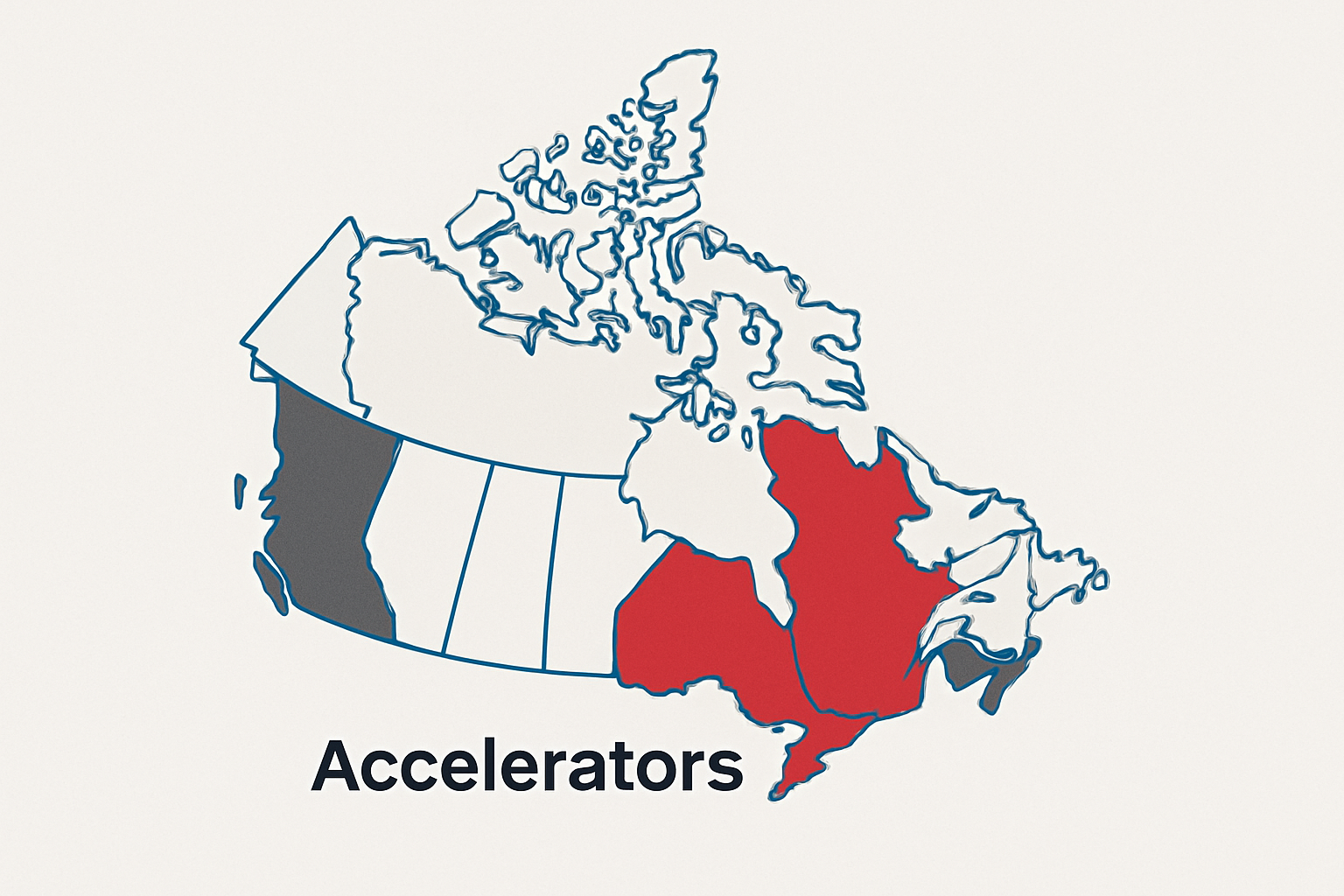
Best Accelerators by Province: Ontario, BC, Quebec, Alberta
Canada’s accelerator landscape is not national in practice. It is provincial by design, shaped by local industry strengths, talent pipelines, and funding structures. Founders who understand this outperform those who apply broadly without regional intent. In 2026, the strongest accelerator outcomes come from matching company stage and risk profile to the province that is structurally best equipped to reduce that risk.
This guide breaks down the most effective accelerators by province and explains why each region works for certain types of companies. It also shows how to use city-level programs as stepping stones rather than isolated bets.
Ontario: Go-to-Market Depth and Investor Density
Ontario remains the most diverse and capital-dense accelerator environment in Canada. Programs here are strongest in B2B software, fintech, enterprise platforms, and regulated markets. The common thread is commercial rigor. Accelerators in Ontario expect founders to engage real customers, test pricing, and understand buying processes early.
Toronto-based programs tend to focus on commercialization, partnerships, and investor readiness. They are well-suited for founders who already have product direction and need to convert traction into repeatable revenue. Waterloo programs lean more technical and are often tied to university ecosystems, making them effective for founders with strong engineering depth who are still refining product-market fit.
Founders should use Ontario accelerators sequentially. City-level programs help clarify fundamentals, while larger provincial or national programs help surface companies to later-stage capital. ShoutEx’s Toronto, Waterloo, and Ontario city guides break down these local options and entry criteria in detail.
British Columbia: Product-Led and Global Orientation
British Columbia’s accelerator ecosystem is smaller but more focused. Programs here tend to favor product-led companies, climate innovation, and startups with early global ambition. Customer validation and product clarity matter more than aggressive scaling narratives.
Vancouver-based accelerators often emphasize early customer discovery, design discipline, and international expansion pathways. This makes BC a strong fit for founders building products with global applicability who want to test demand early without heavy enterprise complexity.
BC programs work best for teams that already have a clear product hypothesis and want fast feedback. ShoutEx’s Vancouver and BC city articles outline the most active programs and how they differ by stage.
Quebec: Technical Rigor and Research Alignment
Quebec stands apart for its technical depth. Accelerators in this province are closely linked to universities, research institutions, and advanced industry clusters. They are particularly effective for AI, deep tech, life sciences, and research-driven startups.
Programs here expect founders to defend technical assumptions and demonstrate intellectual rigor. Market narratives matter, but they must be grounded in credible technical foundations. For founders with strong research roots or complex technology, Quebec accelerators provide validation that is respected by investors nationally and internationally.
Montreal-based programs dominate this landscape, and ShoutEx’s Montreal and Quebec city guides provide a detailed comparison of local options and their expectations.
Alberta: Applied Innovation and Capital Efficiency
Alberta’s accelerator ecosystem has matured rapidly, especially in applied AI, energy transition, industrial software, and data-driven platforms. Programs here are often tightly aligned with non-dilutive funding, pilot opportunities, and real-world deployment.
Accelerators in Calgary and Edmonton emphasize practical outcomes. Founders are expected to demonstrate how their technology applies in operational environments, not just how it performs in theory. This makes Alberta particularly attractive for startups that benefit from early pilots and industry access.
ShoutEx’s Alberta city content outlines how these programs connect to provincial funding and corporate partners.
How to Choose Regionally, Not Emotionally
Founders often choose accelerators based on reputation or proximity. Stronger outcomes come from choosing based on risk alignment. Ontario reduces go-to-market and fundraising risk. BC reduces product and early customer risk. Quebec reduces technical credibility risk. Alberta reduces applied deployment and capital efficiency risk.
The right province is the one that pressures your weakest assumption at the current stage of your company.
Final Perspective
Accelerators are not interchangeable. In Canada, they are regional instruments. Founders who understand provincial strengths and use city-level programs deliberately build momentum faster and with less friction.
Treat accelerators as part of a geographic strategy, not a resume line. That mindset shift alone improves outcomes.
Disclaimer
This content is for general information only and does not constitute legal, financial, or investment advice. Program availability, focus areas, and selection criteria evolve; founders should verify details directly with each provincial or local organization before applying.
ShoutEx Insights
- Canadian Startup Ecosystem: Ultimate Guide 2026
- Complete Guide to Canadian Startup Accelerators and Incubators
- DMZ vs Creative Destruction Lab vs Velocity: Accelerator Comparison
- How to Get Accepted into Top Canadian Accelerators: Application Guide
- Toronto's Startup Ecosystem: Canada's Tech Capital
- Vancouver's Startup Ecosystem: BC's Tech Innovation Leader
- Montreal's Startup Ecosystem: Quebec's Innovation Powerhouse
- Calgary's Startup Ecosystem: Alberta's Energy and Tech Hub
- Halifax's Startup Ecosystem: Atlantic Canada's Tech Leader
Further Readings:
- Hiring Trends in Canada
- MaRS Discovery District: Ontario's Leading Innovation Hub
- Launch Academy: Vancouver Startup Support
- District 3: Montreal Innovation Center
- Platform Calgary: Alberta Accelerator
- Propel ICT: Atlantic Canada Tech Accelerator
- Communitech: Waterloo Region Programs
- Innovate BC: Provincial Accelerator Network
- Canadian Innovation Commercialization Program
Last updated by the Team at ShoutEx on January 19, 2026.
Frequently Asked Questions
Why does it matter which province I choose for an accelerator in Canada?
Each province has different industry strengths, capital networks, and support structures. Matching your startup’s main risk—go‑to‑market, product, technical, or deployment—to the province best equipped to reduce that risk leads to faster learning and better funding outcomes.
What kinds of startups are best suited to Ontario accelerators?
Ontario, especially Toronto and Waterloo, is strongest for B2B software, fintech, enterprise platforms, and regulated markets. Programs here are ideal if your primary challenge is go‑to‑market rigor, complex buying processes, or investor access rather than raw technology validation.
When does British Columbia make more sense than Ontario?
BC is a better fit if you are building a product‑led company with early global ambition, climate or sustainability angles, or strong design and UX focus. Vancouver programs emphasize early customer discovery, product clarity, and international expansion more than deep enterprise complexity.
Which startups should prioritize Quebec accelerators?
Quebec is particularly attractive for AI, deep tech, life sciences, and research‑driven companies. If your biggest risk is technical credibility or sophisticated R&D, Quebec’s university‑linked and research‑aligned programs offer the kind of expert scrutiny and validation investors take seriously.
What type of company benefits most from Alberta accelerators?
Alberta programs are well‑matched to applied innovation in energy transition, industrial software, and data‑driven platforms. If your advantage depends on pilots, field deployments, or tight integration with industrial partners, Calgary and Edmonton accelerators can be especially effective.
How should founders use city-level programs within each province?
City‑level accelerators are best used as stepping stones: first to clarify fundamentals (problem, customer, GTM motion), then to graduate into larger provincial or national programs. Treat them as a sequence that compounds learning rather than isolated one‑off experiences.
What is the right way to choose regionally, not emotionally?
Start by writing down your startup’s single biggest current risk. Then map provinces to the type of risk they reduce best: Ontario for go‑to‑market and capital, BC for product and early customers, Quebec for technical rigor, Alberta for applied deployment and capital efficiency. Choose the region that will pressure that weakest assumption now.